Bangley’s grenades
The Dog StarsBangley’s grenades are both a practical weapon and the material proof behind Hig’s threats. Six explosives appear together in a basket, then become portable tools of intimidation and possible violence. Hig calls them Eggs of Death; in his hands, that name carries a tension the episodes repeatedly sharpen: he wants the force to be understood, but tries to direct it away from the people he is confronting.
Discovery and Naming
The grenades enter view in a basket Bangley hands to Hig. Afterward, Bangley turns to a stepladder, chops at its locking struts until it is partly folded, and carries it back to the pump. The contents of the basket are then revealed: six grenades. Their arrival is linked to Bangley’s work on a launcher, which prompts him to say that the work had got him thinking. The account does not explain the launcher’s design or establish that the grenades are used with it; it does establish that the project led Bangley to reconsider what he already had.
Hig sees the grenades arranged in the basket as eggs in a nest and gives them the name Egg of Death, recalling a fairy tale he once read but cannot remember clearly. The image makes the weapons seem at once gathered and dormant: they lie together, waiting to be taken up, while their harmless-looking nest shape is set against what they can do. Hig’s forgotten fairy tale supplies no explanation, but the act of naming turns a cache of explosives into a memorable object in the story’s vocabulary. He later uses the plural Eggs of Death, carrying that name from the basket into moments when their lethal purpose is immediate.
Carried Into Danger
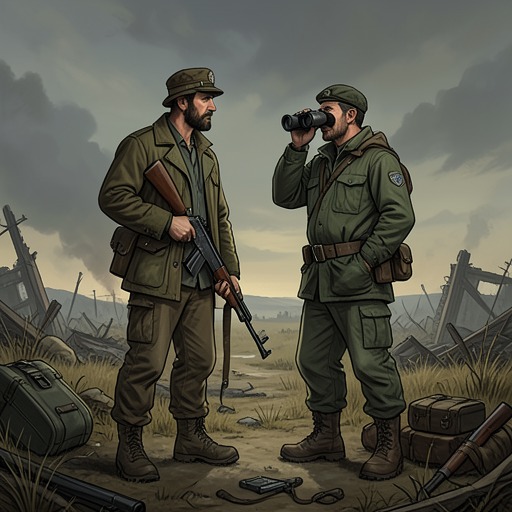
Before leaving the Beast after a risky bush landing, Hig ties the aircraft down facing its takeoff direction and assesses how little fuel remains. The digital gauge shows just over twelve gallons; even with the fuel in two jugs, he does not have enough to return. He decides he may still be able to reach Junction, but first pours the last fuel from the jugs into the wing tanks. Only after this preparation does he put two of Bangley’s Eggs of Death into his jacket pockets, sling the AR-15 over his shoulder, and walk away from the plane.
This is not an incidental detail of his equipment. The grenades go with Hig as he leaves behind his means of escape and sets out with limited fuel and a firearm. He also takes the aircraft key and deliberately tells himself where it is, anticipating that he may later need to act in a hurry. In that sequence, the grenades belong to a larger calculation of risk: Hig is preparing for danger, but also trying to preserve the possibility of returning to the Beast. Their portability makes them available for a confrontation beyond the aircraft, while their presence underscores how much the journey depends on balancing preparation against the chance of getting back.
A Demonstration of Force
In a later standoff, Hig communicates with the people on the other side of a lip by writing messages on paper and holding them up. One reads, “I-COULD-BLOW-YOU-TO-SMITHER-EENS-BUT-I-WON’T—PEACE”. The statement offers restraint while making the threat explicit. Hig then takes an Egg of Death from his pocket, pulls its stiff pin, and throws it over the edge.
The choice of where to throw it matters. Hig aims well upstream, toward what he imagines as the upper meadow, away from the cows and from the man and girl he has been addressing. The grenade explodes. Its blast does not strike the people he is trying to frighten, but it changes the force of the exchange: the possibility announced in his message has become a sound and an actual detonation. While his opponents are still rattled and checking themselves for injuries, Hig sends another message: “SEE?-NEXT-ONE-MIGHT-HURT”. The first explosion therefore serves as a demonstration, and the next threat is more credible because the grenade has already proved that Hig can act.
The objects enable a narrow, dangerous form of communication. Hig does not simply display a grenade or fire at the people across from him; he detonates one at a distance he judges safe for them, then links that controlled blast to a warning about what could follow. The text records both the explosion’s satisfying effect on Hig and his care to keep it away from the cows and the people. Restraint is present, but it is expressed through a weapon that makes the risk of abandoning restraint impossible to miss.
Meaning and Consequences
The name Eggs of Death holds together the grenades’ contrasting roles. In the basket, they look like clustered eggs; in Hig’s pocket, they become a threat he can carry; once the pin is pulled, one produces an explosion that unsettles the people he wants to control. The change is not merely symbolic: each shift in how Hig handles the objects alters the stakes of the encounter, from stored potential to a demonstrated capacity for harm.
The scene also distinguishes threat from indiscriminate attack. Hig’s message claims the power to destroy his opponents, but his throw is directed away from them and the cattle. The blast frightens them without being aimed at their bodies, and the follow-up message warns that a later grenade might not be so harmless. This does not erase the danger: Hig has used an explosive to compel attention, and the promise of greater harm now rests on a demonstrated capability. Bangley’s grenades thus give physical weight to the uneasy peace Hig proposes, making the boundary between protection, coercion, and violence visible in a single thrown object.